Most men who call us have already tried to handle things on their own for a while. Maybe a long while. By the time someone picks up the phone, the question is rarely “do I need help?” It’s usually closer to “what does getting help actually look like, and will it work for someone like me?” Rehab for men in Madison, WI at Willow starts with that question. The first conversation is just a conversation.


Men wait. We see it constantly. Not because the problem isn’t real, but because asking for help runs against a lot of what men are taught from early on. Push through it. Handle it yourself. Don’t make it anyone else’s problem. By the time someone actually calls, they’ve usually been managing something difficult for much longer than they needed to.
The numbers back that up. Men are more likely than women to develop a substance use disorder, and less likely to get into treatment for it. The longer that gap stays open, the more other things start to slip: work, relationships, physical health. None of that is inevitable, but it does tend to move in one direction when nothing changes. Getting into a program sooner doesn’t mean things have to be at their worst first.
Most guys assume that getting help means dropping everything for weeks or months at a time: work, family, routine, all of it. Not here. Partial hospitalization programs (PHPs) run during the day, Monday through Friday. You come in, do the clinical work, and go home at night. Life keeps going while the harder work gets done alongside it.
Intensive outpatient programs (IOPs) meet a few times a week, which fits better for someone who’s working or has family obligations he can’t set aside. Many men move into IOP after completing PHP to keep support going at a lower intensity. Can’t make it in person? Virtual sessions run the same way, just through a screen. Most men are surprised by how much flexibility is actually available.
Stopping substance use is one part of it. The part that takes longer is figuring out what was driving it, why it was hard to stop, and what actually needs to shift so the same thing doesn’t keep happening. Therapy is where that work gets done. Approaches here are chosen based on what the research shows works, not what sounds good on paper.
CBT is one of the main tools we use for drug rehab and alcohol treatment for men. It helps identify the thought patterns that feed substance use and gives men a concrete way to start responding differently. A lot of men don’t realize how automatic those patterns have become until they start looking at them. DBT comes in when emotional regulation is the bigger challenge. For men who tend to shut down or escalate under pressure, those moments are often right where relapse starts, and DBT builds specific skills to handle them differently.
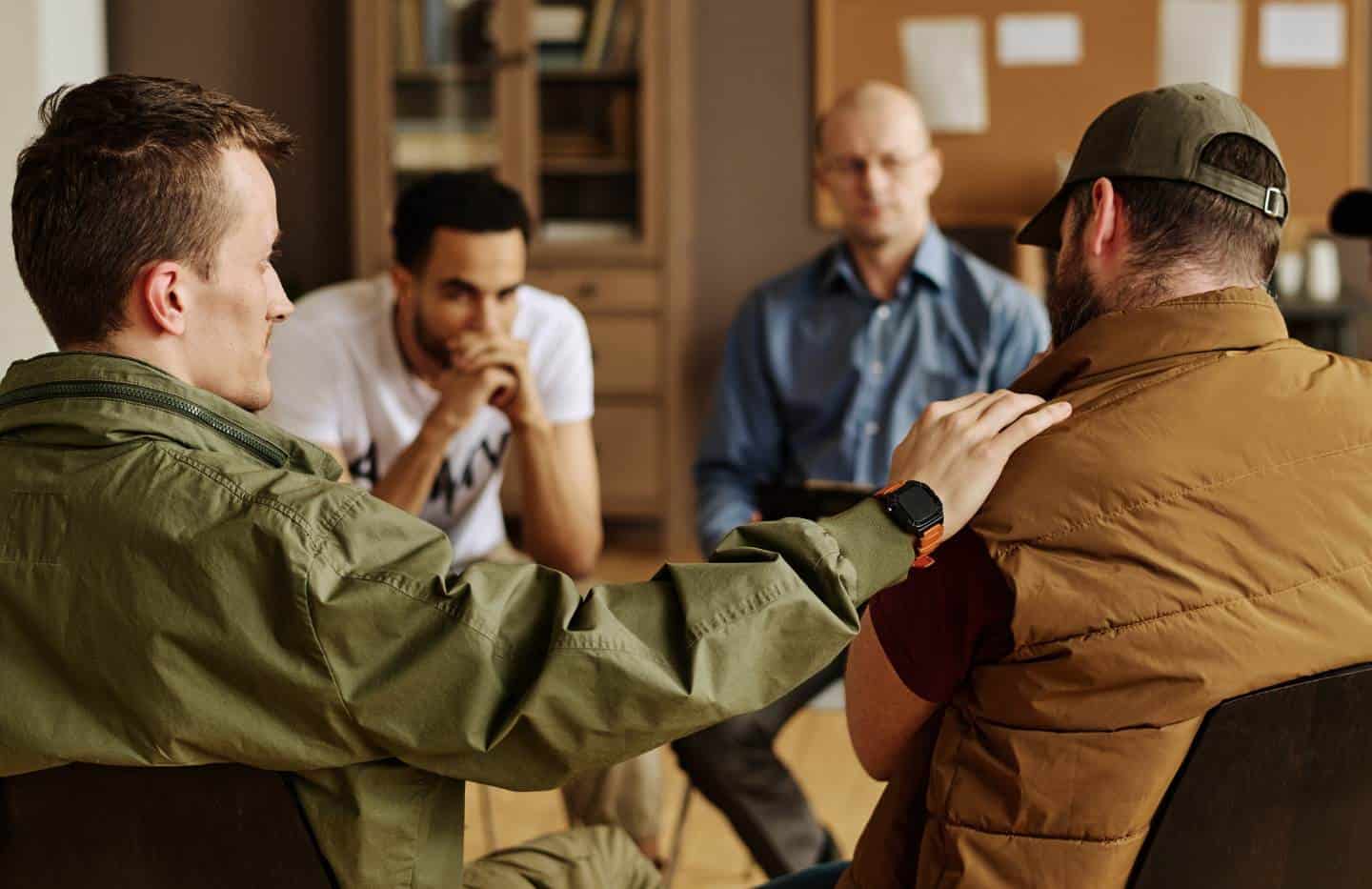
Individual therapy gives you a private space to work through your own history without an audience. Group sessions are different — there’s something useful about being in a room with other men who are dealing with real versions of the same thing, not sanitized versions. Family therapy is also available, as the people closest to you can affect how sustainable your progress is once the program ends. Those relationships are worth being part of the process.
Medication-assisted treatment (MAT) is an option for men dealing with physical dependence. It uses FDA-approved medications to reduce cravings and ease withdrawal, so early recovery isn’t entirely a white-knuckle experience. Trauma also comes up a lot in this work. A significant number of men dealing with substance use have unresolved trauma running underneath it, and the clinical team is trained to approach that history without judgment and without rushing past it.
Dual diagnosis refers to the presence of both a mental health condition and a substance use disorder at the same time. According to SAMHSA, approximately 21.5 million adults in the United States live with a co-occurring disorder. Men represent a significant portion of that group, and their mental health symptoms are more likely to go unrecognized. Those symptoms often show up as irritability, social withdrawal, or increased substance use rather than the signs more commonly linked to depression or anxiety.
Treating one condition while the other goes unaddressed is one of the most common reasons people end up back where they started. If the anxiety driving the drinking never gets touched, stopping the drinking only solves part of the problem. Our dual diagnosis program puts both conditions in front of the same clinical team so neither one gets treated like a footnote. One assessment, one plan, and a team that actually understands how the two interact. In most cases, they do.

Wisconsin’s own data tells a pretty clear story. According to the Wisconsin Department of Health Services, alcohol and opioids lead to substance-related hospitalizations and ER visits statewide. Men show up in those numbers at a disproportionate rate. For guys in Madison, having a program nearby means not having to choose between getting help and keeping life intact.
Proximity to care also affects whether someone follows through with treatment. Men who access drug rehab centers for men in Wisconsin without traveling long distances are more likely to complete a full course of care. They also tend to stay more consistently connected to continuing support afterward. Willow’s Madison location keeps that support reachable without requiring someone to step entirely out of their life to access it.
One of the questions we hear most often is what actually happens after someone calls. The intake process at Willow starts with a clinical assessment, not paperwork and waiting. A member of the team will ask about your history with substances, any mental health concerns, your current living situation, and your schedule. All of that information shapes which level of care is the right fit and how the plan gets built.
From there, a plan gets built around your actual situation. Two weeks in, things often look different from what they did at the start, and the plan adjusts with that. Nobody is locked into an approach that no longer fits. Aftercare is also part of the conversation from the beginning. Leaving with something workable for what comes next matters as much as getting through the program itself.

When you are ready to talk, someone at Willow is ready to listen. Rehab for men in Madison, WI, does not have to mean starting over from scratch or putting everything in your life on pause. It means getting honest clinical support from a team that understands what men are actually dealing with and knows how to help. Call us, and we can figure out the right next step together.
These are questions that come up often during that first conversation. The answers are meant to be straightforward.
Men’s programming addresses patterns that show up specifically in how men experience and respond to substance use, including how mental health symptoms tend to present differently. The clinical approach reflects that without treating it as a niche distinction.
That gets sorted out during the intake assessment, not before it. A clinician looks at your history, current situation, and what you’re managing day to day before making any recommendation.
Not necessarily. Many people participate in outpatient programs without disclosing anything to their employer, particularly at the IOP level, where scheduling flexibility is built in. An admissions team member can talk through what that looks like for your specific situation.
It’s one of the most common things we hear. A previous program that didn’t work doesn’t mean treatment won’t work. It often means something wasn’t the right fit, whether it was the level of care, the approach, or a co-occurring condition that wasn’t addressed. The intake assessment specifically looks at that history.
Many insurance plans cover outpatient programs, including PHP and IOP, though what’s covered varies by plan. The admissions team can verify benefits before the first appointment, so there are no surprises on the day you begin care.

Everyday mood swings may be brief and connected to a clear trigger: an argument, a rough night of sleep, or a stressful day. Bipolar disorder involves manic or depressive episodes that last at least several days to weeks and are severe enough to disrupt sleep, judgment, and daily functioning. A

If your antidepressant doesn’t feel like it’s working, that doesn’t mean it has failed. Full effects can take several weeks to emerge, and a fair trial lasts about 12 weeks. Only about a third of people get lasting relief from their first medication. Dose, timing, an undiagnosed condition, life stress,

For many people with mild-to-moderate anxiety, it can. Cognitive behavioral therapy (CBT) has strong evidence for lasting symptom reduction on its own. Research shows CBT and medication can work equally well for some people. When anxiety is more severe or has not improved with therapy alone, combining therapy and medication